
Permanent Holiday Lighting San Diego | What to Know Before Buying
A permanent holiday lighting system is a track of individually addressable LED points, color-matched to your fascia and installed tight against it, that stays on the house year-round. You control it from your phone. Warm white most of the year if you want it, color for the handful of nights you do.
It is the opposite of the annual ritual: nobody on a ladder in November, nobody untangling anything in January, no boxes in the garage.
That’s the product. This is what nobody tells you before you buy one.
The question everyone asks first
“Won’t my house look like it has Christmas lights on it in July?”
Honest answer: it depends almost entirely on the installation.
A well-fitted track is color-matched to your fascia and sits tight against it. From the street at midday, most people don’t register it. A poorly fitted one — wrong color, visible gaps, sagging runs, exposed wire at the corners — you’ll notice every single day for the next fifteen years. So will your neighbors.
Same product. Two crews. Two completely different outcomes.
That gap is the single most important thing to understand about this category. The hardware is broadly similar across the industry. What you’re actually buying is the quality of the install.
The one test that tells you everything
Before you sign anything with anyone, ask for a photograph of a finished install taken at midday, from the street.
Not the December night shot. Everybody has that one, and everybody’s looks good — a lit roofline at night is flattering no matter how it was installed. The daylight photo is the one that shows the truth: whether the track color actually matches the fascia, whether the runs are straight, what happens at the corners, how the wire is handled where it meets a downspout.
Some companies won’t have that photo. A few will get uncomfortable when you ask. That’s useful information, and it costs you nothing to find out.
Three arrival mistakes worth fixing
What separates a good install from one you regret
Color match. Track comes in a range of finishes. It should be specified against your actual fascia color, not chosen from a default. A white track on a bronze fascia is visible from a block away.
Fit against the fascia. Tight, continuous, no daylight showing between track and board. Gaps collect debris and read as an add-on rather than part of the house.
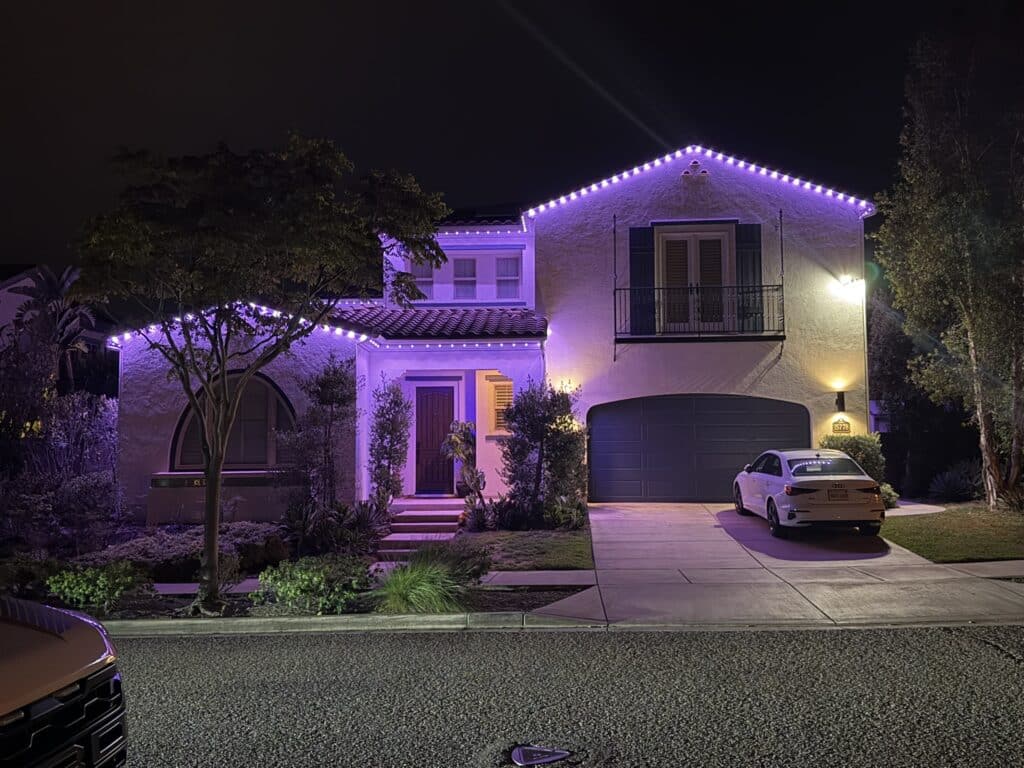
Corners and transitions. This is where installs fail. Where the roofline changes pitch, meets a downspout, or turns a corner, a rushed job leaves a visible jog, a gap, or loose wire. A careful one resolves it cleanly. Corners are what you should be looking at in any photo you’re shown.
Following the architecture. Good roofline work traces the structure — the main fascia, the peaks that matter, the lines the architect drew. It doesn’t outline every available edge simply because the edge is there. More coverage is not better coverage.
Wire management. No visible runs down the face of the house. No conduit where there doesn’t need to be. The transformer and controller placed somewhere serviceable and out of sight.
What actually drives the cost
There’s no square-footage formula, because the variables are real:
- Linear footage of fascia you’re covering, which is the baseline
- Roof complexity — a simple two-plane roof and a home with six gables and three dormers are very different projects at the same linear footage
- Height and access — second and third story runs, steep pitch, and limited ladder access all add labor
- Fascia condition — track needs something sound to mount to
- Controller and zoning — whether the house runs as one zone or several you can address independently
- Integration — whether the system is coordinating with existing landscape lighting on the property
The useful thing to know going in is that a low bid usually means one of two things: fewer linear feet than you think you’re getting, or labor pared down at the corners and transitions — which is precisely where the install will fail visually. Ask any bid to specify linear footage covered and how transitions are handled, and the cheap ones tend to explain themselves.
Year three is the honest test
Most companies selling these systems talk about the install. Almost nobody talks about year three.
These systems are durable but not immortal. They live outside — sun, salt air near the coast, roofers, gutter cleaners, the occasional palm frond. Over years, things happen. A section stops lighting. A controller needs replacing. A connector corrodes.
Most of it is fixable in under an hour by someone who knows the system. The lights are addressable, which means a failure is usually a section rather than the whole run, and it can be isolated and swapped without touching the rest of the house.
The part that decides your experience is who picks up the phone.
A warranty is only as good as the company willing to come use it. The parts may be covered for years. Nobody at the factory is getting on your roof.
So the questions worth asking any installer:
- Are you local, and how long have you been doing this specific work?
- If a section goes dark in December, who comes, and how fast?
- Is programming support included, or is that a service call?
- What happens in year five when the controller needs replacing?
Our own installs include a complimentary year of Roofline X Care — programming support when you want colors changed or a scene set up, inspection whenever you ask, and someone to call if a section goes dark. Beyond that, the controller and track carry their own manufacturer warranty. We’re a San Diego company and Matt has been installing and servicing lighting for nearly ten years. If you have a problem, you call us and we come. Not a call center, not a warranty portal.
The thing most people realize a year later
Almost nobody buys this for Christmas.
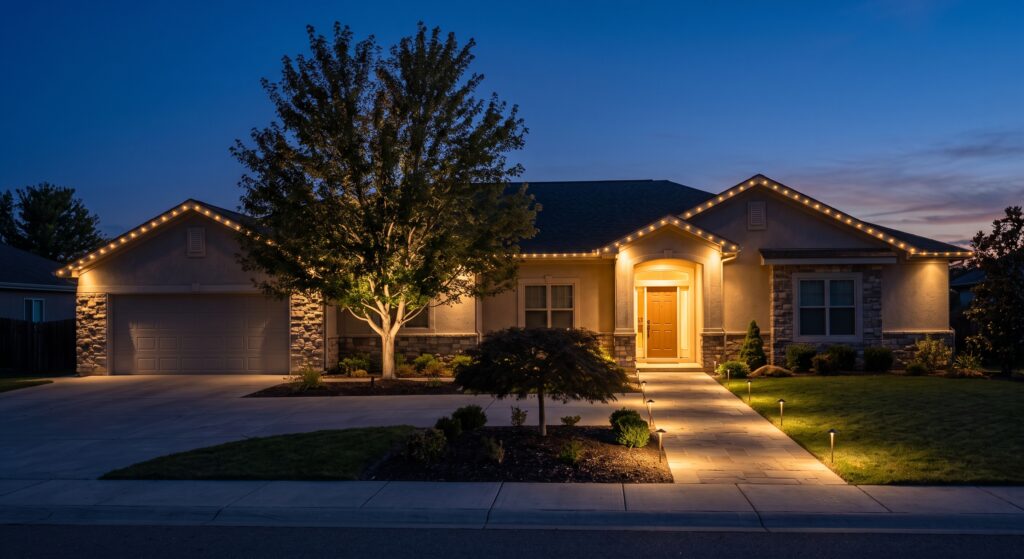
They buy it for Christmas, and then discover they use it eleven months a year — warm white along the roofline on an ordinary Tuesday, which turns out to make the house look considered rather than decorated. The holiday weeks are a few nights of color inside a system that’s quietly improving the house every other night.
Which is why it’s worth thinking about alongside your landscape lighting rather than separately. A roofline lit above a dark property looks like a decoration floating in the air. A roofline lit above a well-lit garden reads as one composition — the architecture and the landscape holding together after dark.
If you’d like to see what yours would look like, send us a photo of your roofline and we’ll tell you honestly what we’d do with it.