
The Difference Between a Lit Yard and an Inviting One
Most homeowners have had this moment without naming it. You step outside after dark, the lights are on, everything is visible — and you go back in.
Nothing was wrong. The yard was lit. It just wasn’t somewhere you wanted to be.
That gap is most of what we do. And it has less to do with fixture count than people expect. You can put forty fixtures on a house and have it look harsh. You can put forty on the same house and have it look like the best property on the street. Same number, entirely different decisions.
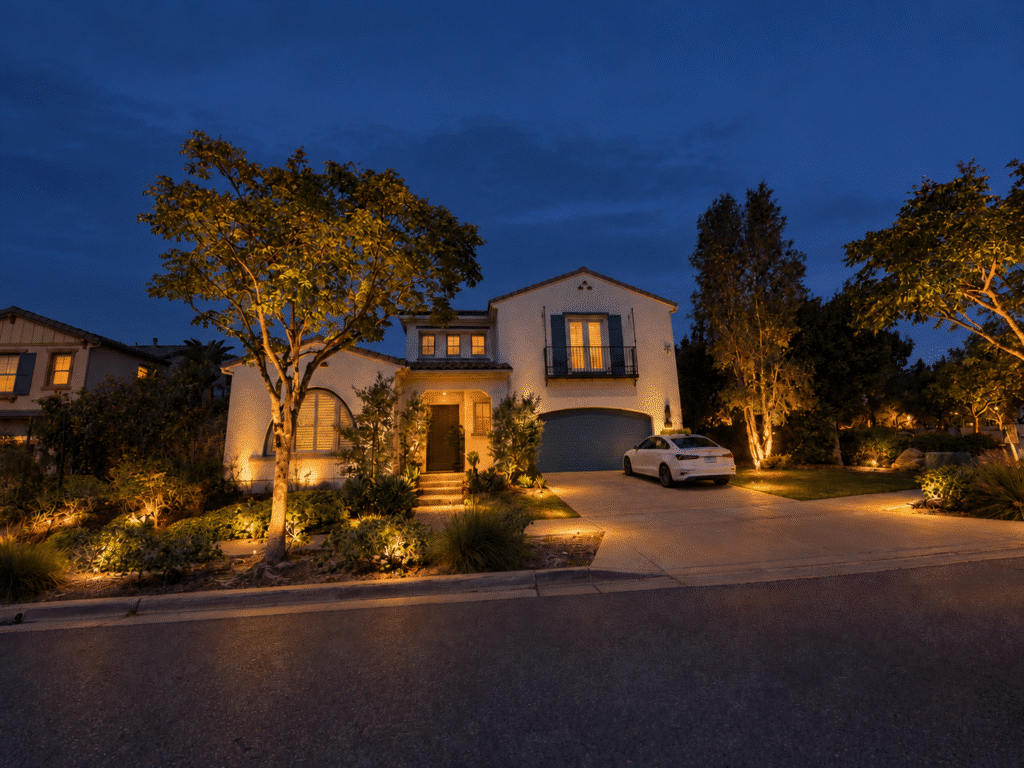
Layers
A single bright source makes a patio visible and flattens it. Everything reads at one intensity, the eye has nowhere to travel, and the space feels like a loading dock with furniture in it.
What makes an outdoor space feel like a room is light at different heights doing different jobs. Low along the paths, so people walk without looking down. Up into trees and architecture, giving the space a ceiling. A wash on walls to define the edges. Something from above, through a canopy, falling the way moonlight does.
Each layer does a small amount of work. Together they build depth — and depth is what the eye reads as comfortable rather than illuminated.
Color temperature is a tool, not a rule
Most of what we install sits around 2700K — soft and warm, the way candlelight reads. For stone, stucco, architecture, and entertaining areas, it’s almost always right.
Cooler light behaves differently. It renders green more vividly. Foliage that looks muddy under a very warm source comes alive under something cooler. Palms, ferns, anything chosen for the color of its leaves often wants a different temperature than the wall behind it.
So we don’t use one temperature everywhere. We choose deliberately.
The problem isn’t mixed temperature — it’s accidental mixed temperature. One fixture replaced years later with whatever was on the shelf, sitting in a warm run like a chipped tooth. That’s drift, not design.
Intentional mixing is something else: a cooler source bringing out the green of a specimen tree while warmer light holds the terrace beneath it. The eye doesn’t register two temperatures. It registers depth. Knowing which surfaces want which — and when to break your own convention — is much of what separates putting fixtures in the ground from designing with intention.
You may need more lights, not fewer
This is where homeowners brace themselves. We’ll propose thirty or forty fixtures and the reaction is immediate: we don’t want it to look like Christmas.
Fair instinct. But the number isn’t the problem. Uniformity is.
Forty identical fixtures at identical output will look relentless. Forty different fixtures — a mini under a low shrub throwing almost nothing, a tight spot reaching into a canopy, a wide flood grazing a long wall, a downlight set high in a tree — don’t read as forty lights. They read as one scene with dimension in it.
Three variables do the work. Type: a path light, a mini, a well light, and a wall graze each exist because there’s a job the others do badly. Output: a fixture meant to whisper under a planting bed and one meant to reach the top of a mature pine shouldn’t match. Beam spread: a narrow spot concentrates and travels; a wide flood spreads and softens. Point a flood at a tall tree and most of it lands on your neighbors.
Get those right and a high fixture count disappears into the landscape. Get them wrong and six will look like too many.
Glare, not brightness, is the enemy
Good lighting is felt more than seen. You should notice the illuminated olive tree, not the fixture pointing at it.
A visible bulb in your sightline pulls attention to hardware — and contracts your pupils, making everything else look darker than it is. One glaring fixture can undo six good ones. Shielding, aiming, and placement matter as much as wattage, which is why a property can hold a lot of light and still feel soft.
Darkness, and the shadows you choose
A property where every corner is lit has no shape. Contrast creates interest: a pool of light, then shadow, then another further on, so the garden feels like it continues past what you can see. Darkness is also how you create intimacy — a terrace surrounded by dimmer surroundings feels private; the same terrace lit evenly feels exposed.
Placement decides the shadow. Most people assume you light an object from the front. Often you do. But put a source behind a sculptural plant — an agave, a Japanese maple — and you light the wall instead. The plant becomes a silhouette. It stops being a plant and becomes a shape. Graze a textured wall from a steep angle and every imperfection throws its own small shadow. Set a downlight high in a tree and the canopy prints its pattern on the terrace below.
In each case the shadow is the point, and the light is only how you make it. At night, the architecture and the landscape become artwork — and shadow is half the medium.
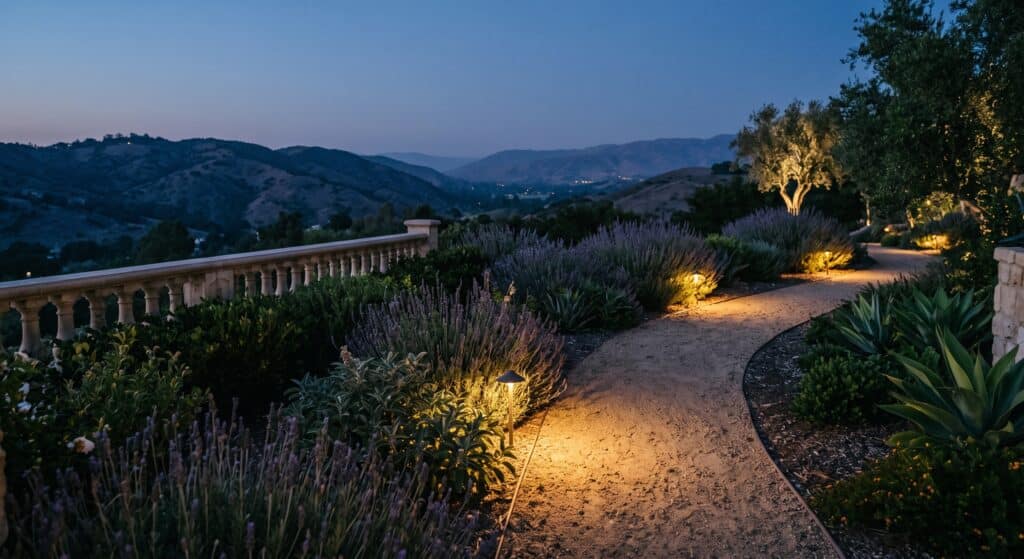
Between October and February we lose usable evening fast here; sunset falls before five for months. Which light, aimed where, at what temperature, with what spread — and what you deliberately leave dark — is the difference between seeing your property and wanting to be in it.
Go stand in your own yard after dark one evening. Not to inspect it. Just to see whether you want to stay.