
Outdoor Lighting for Fall & Winter Evenings | San Diego
Daylight saving ends November 1 and San Diego sunset drops to just before five. What warm, layered landscape lighting does to the five months that follow.
Right now the sun sets a little after six. On November 1, daylight saving ends and it drops to just before five — and it stays there until spring.
Which means that from next month on, it will be dark outside before most of us have finished the workday.
Consider what that actually costs you. The landscape you planned. The stonework. The mature trees, the lines of the house, the details you chose carefully and paid for once. For the next five months you’ll see all of it on weekend afternoons, and almost never during the hours you’re actually home.
It doesn’t disappear. It just goes invisible.
What a well-lit evening actually looks like
Picture a Friday in late November. It’s a little after seven.
The table on the terrace is set, and the space around it feels like a room — warm, contained, unhurried. A soft glow washes the stone wall behind you. The olive tree at the edge of the terrace is lit from below, its canopy holding the light like a ceiling.
Beyond that, the garden hasn’t disappeared into a black wall. The path curves away in gentle pools of light. The architecture of the house — the lines that were chosen carefully, once — reads just as well at night as it does at noon.
Nobody suggests moving inside. The conversation runs long.
That evening has almost nothing to do with how much light there is.
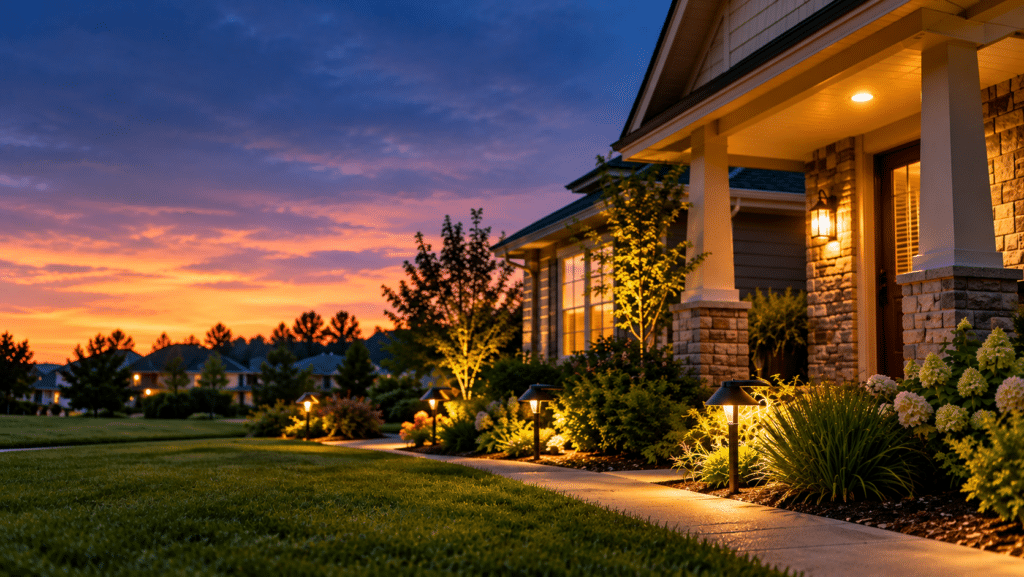
It isn’t about more light. It’s about the right light.
A single bright fixture will illuminate a patio. It won’t make anyone want to linger there. The difference between a lit yard and an inviting one comes down to four decisions.
Layers, not floodlights
Low path lighting, soft uplighting on trees and architecture, and a gentle wash on garden walls — working together at different heights, so the eye has somewhere to travel. A single source flattens everything it touches. Several quiet sources give a property depth, and depth is what makes a space feel like a room rather than a lawn with a lamp on it.
Warm light, always
Cool white light reads as security lighting. Warm light reads as candlelight, firelight, sunset. It is the single biggest factor in whether a space feels welcoming or institutional — and it’s the most common reason a homeowner looks at a newly lit yard and can’t quite say why it feels wrong.
Glare control
Well-designed lighting is felt more than it is seen. You should notice the illuminated olive tree, not the fixture pointing at it. Shielding, aiming, and placement do more for the finished result than the fixture itself ever will.
Timing that follows the season
Sunset moves by roughly a minute a day through the fall. A fixed timer is wrong within a week. An astronomic timer tracks the sun and moves with it, so the garden is already glowing when you step outside and nobody touches a switch — which matters more between November and March than at any other time of year.
What San Diego evenings ask for specifically
Coastal properties and inland ones behave differently after dark.
Near the water — La Jolla, Del Mar, Coronado — marine layer softens and scatters light. Fixtures that look right on a clear night read hazy on a damp one, and salt air is unforgiving on anything but well-specified hardware. Brass and copper age well here. Cheaper aluminum does not, and you find out in year three.
Inland — Rancho Santa Fe, Poway, Fairbanks Ranch — properties are larger, darker at the edges, and mature planting does most of the work. The design question is usually less about how to light the house and more about how far into the property the eye should be invited to travel.
Neither is a matter of a bigger system. Both are a matter of a considered one.
Two questions worth asking anyone you talk to
Landscape lighting is an unregulated category, and the visible difference between careful work and careless work doesn’t show up for two or three years. Two questions separate most of the field, and neither requires you to know anything technical.
“Will you aim the fixtures at night?”
Every fixture should be set after dark, on site, by someone standing in the garden watching the effect. Four degrees is the difference between a canopy that glows and a trunk with a light on it. Aiming in daylight is aiming at a guess, and it’s the most commonly skipped step in the industry because it means coming back for an extra evening.
“Can I see a property you lit three years ago?”
Anyone can show you install-night photos. What you want to know is what the work looks like after the planting has grown, the lenses have been through a few seasons of salt air, and a few fixtures have been replaced. That’s the real portfolio.
One more thing this season
If the roofline is also on your mind — the permanent systems that go up once and stay — it’s worth thinking about the two together rather than separately. A lit roofline above a dark property reads as a decoration floating in the air. Above a well-lit garden, it reads as one composition.
We wrote separately about [what to know before buying permanent holiday lighting], including the one photograph worth asking every installer for.
A thought for this month
The next clear evening, step outside just after dark and look at your own property the way a guest would.
What draws your eye? What disappears entirely? Is there anywhere you would actually want to sit?
Most homeowners are surprised by the answer — and surprised by how little it takes to change it.
If you’d like to see what your home could look like after sunset, we’d be glad to walk it with you.