
Walk & Quick Fix or Service Visit: What Happens When a Light Goes Out
A light goes out. Maybe it’s one path light, maybe a whole side of the garden. The question most homeowners have isn’t whether it can be fixed. It’s how much of a production fixing it will be.
For most repairs, the answer is: not much. Here’s how we keep it that way.
It starts with a few questions
When you call, we’ll ask what’s going on. Is it one light or several? Did it happen all at once? Has anyone been working in the yard? Is the timer or outlet acting up?
Those answers help us decide which visit fits, so the right amount of time is on the schedule before we arrive.
Walk & Quick Fix: about 30 minutes
A Walk & Quick Fix is exactly what it sounds like. From our call, we can often tell what’s likely going on, and we aim to have it handled within about 30 minutes. Common examples:
- A tripped GFCI outlet that needs resetting
- A loose connection
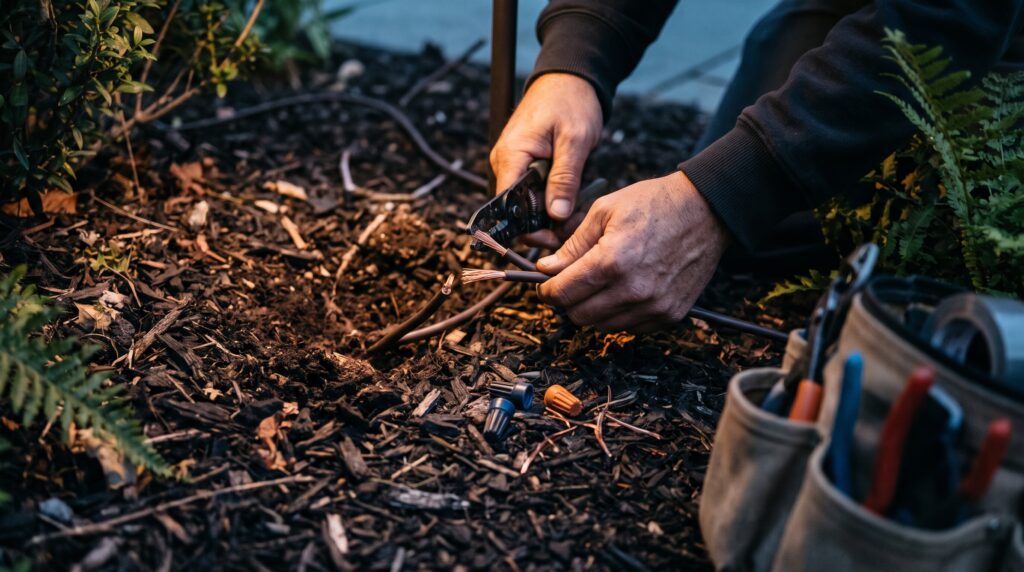
- A wire that’s been cut in a spot we can find and repair quickly
If it’s really a 15-minute fix, this is the win-win. You get it handled without paying for more time than it took.
Service visit: when it needs diagnosing
A service visit is for one specific issue that needs diagnosing, often in one section of your lighting system. A section of lights is out and nothing looks wrong. A light flickers only some nights. We trace the cause and repair it.
Service visits carry a one-hour minimum, then are billed in 15-minute increments after that. That’s exactly why the Walk & Quick Fix exists: a simple fix shouldn’t carry an hour’s minimum.
What if a quick fix turns into more?
When something goes wrong, we check the usual suspects first. Most of the time, one of them is the answer. When none of them turns out to be the cause, the issue is something bigger, and we’ll stop and tell you what we’re seeing.
If we believe we can solve it within about an hour and our schedule allows, we’ll keep going. At that point your Walk & Quick Fix becomes a service visit: the one-hour minimum applies, and any time beyond it is billed in 15-minute increments.
If we can’t finish it then, we’ll schedule a return service visit with the time and parts the repair needs.
When you'd like more than a repair
A Walk & Quick Fix and a service visit focus on one issue. If you’d like an overall look at the entire system, along with some optimization, a system evaluation is the better fit. It’s often where homeowners begin when they’re considering an ongoing care plan.
And if the system needs a true deep dive, such as an older system with many lights out or uneven brightness across the property, or you’d like it repaired and expanded at the same time, that’s a system refresh. A refresh starts with us walking the property with you, then a written proposal before anything is scheduled.
Whichever visit you need, nothing changes course without a conversation with you first.
Where to go from here
If a light has gone dark, call us and tell us what you’re seeing. We’ll help you figure out which visit makes sense, and get your evenings back to the way they were meant to look.
Related: After the Install: The Part of Landscape Lighting We Actually Want to Do · What Happens During a Landscape Lighting System Evaluation
Be good to you,
Elizabeth

Elizabeth Leeds
Co-owner of
X Outdoor Lighting
Elizabeth oversees operations, finance, and marketing at X Outdoor Lighting. Before XOL, she spent 25 years in physical therapy as a Doctor of Physical Therapy and clinical director, specializing in orthopedics and pelvic floor rehabilitation. That work taught her that clients feel cared for when they understand what’s happening and why. She brings the same approach here, with clear communication, thoughtful explanations, and the behind-the-scenes systems that keep every project on track.
After the Install: The Part of Landscape Lighting We Actually Want to Do
October 30, 2026
No Comments
Read More »
The System Refresh: Getting to Know an Older Lighting System
October 30, 2026
No Comments
Read More »